
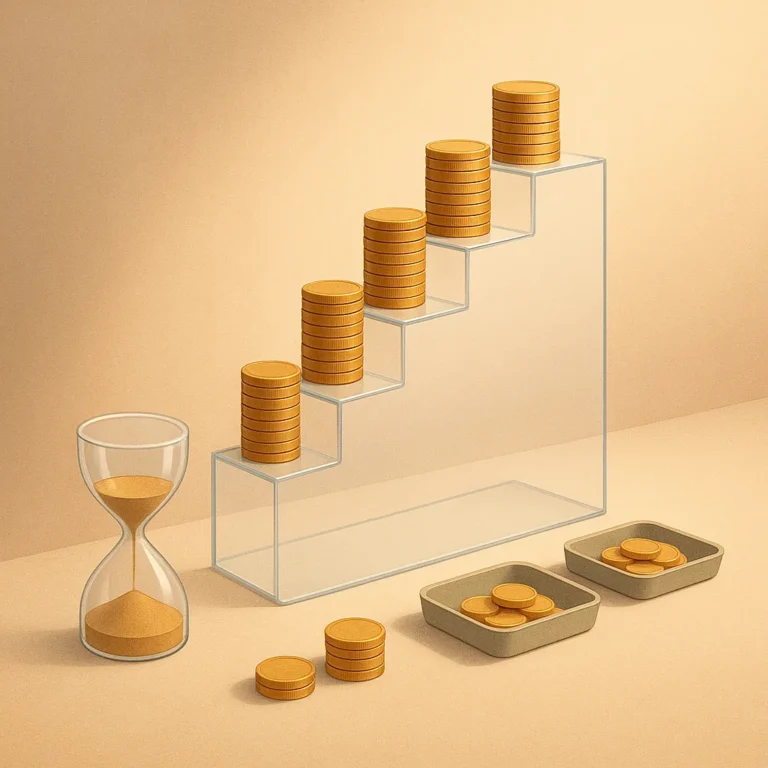
Compound interest describes a process in which returns are added to a balance and then participate in later growth. A deposit can therefore earn on the original money and on earlier credited returns. The mechanism is simple, but its outcome depends on time, contributions, costs, taxes, and changing results.
This article uses a hypothetical example rather than a promise about any investment. You will see how regular deposits, reinvestment, and a chosen annual assumption interact over years. You will also learn to question projections, account for uncertainty, and build a useful routine without confusing an illustration with a guarantee.
Define Compounding in Plain Language
Imagine placing $100 in an account that earns a hypothetical 5 percent during one year, with no fees or additional deposits. A simple calculation credits $5, leaving $105. If the next year also produces 5 percent, the calculation uses $105, so the return is $5.25 rather than another $5.
That extra twenty-five cents is small, yet it demonstrates the central idea: credited growth can itself become part of the base. Bank interest may follow a stated formula, while investment returns fluctuate and can be negative. In either case, compounding is not a magical bonus; it is the result of reinvestment over time.
Set Transparent Example Assumptions
Any projection needs clearly labeled assumptions. State the starting balance, contribution amount, deposit frequency, assumed annual return, time period, and whether deposits arrive at the beginning or end of each period. Also state whether the rate is nominal or adjusted, and whether fees, taxes, and inflation are included.
Separate Contributions From Growth
Suppose a saver starts with $1,000 and adds $100 at the end of every month for twenty years. The saver deposits $24,000 during that period, so total personal contributions equal $25,000 before any growth. If an illustration ends above that amount, the difference represents modeled growth, not free money or a guaranteed result.
Compare Time With Return Assumptions
Now compare two otherwise identical savers using the same hypothetical net return, one beginning at age thirty and another beginning at age forty. The earlier saver has more periods for deposits and previous growth to remain invested. That advantage does not prove a particular outcome, because actual returns, behavior, and circumstances can differ.
Understand Contributions and Consistency
Regular contributions connect the example to real cash flow. A modest amount that fits a monthly budget can matter because each deposit receives its own opportunity to participate in future growth. The amount should remain realistic, however; an impressive projection is less useful if the payment forces debt, missed bills, or fragile finances.
Automation can reduce the temptation to decide every month, but it should not remove oversight. Choose a transfer date after income arrives, check that the amount remains affordable, and pause or reduce it when essential needs take priority. Consistency is valuable, yet flexibility protects the broader financial plan when circumstances change.
Account for Fees, Taxes, and Inflation
Fees can quietly reduce compounding because money paid for an account or service is no longer available to grow. Compare projections using the same starting balance, contributions, and market assumption, then subtract stated expenses. A small annual difference may seem unimportant at first, but its effect can accumulate across many years.
Taxes create another distinction between a displayed return and money available for a goal. Tax treatment depends on the account, jurisdiction, transaction, and personal situation, so a generic example cannot promise an after-tax result. Inflation matters too: even if a balance rises in dollars, future dollars may buy fewer goods and services.
Respect Uncertainty and Market Volatility
Real investment paths rarely move in a smooth upward line. Prices can rise, fall, or remain flat, sometimes sharply, and results may arrive in an inconvenient order. Two accounts with the same average return can finish differently if one suffers losses early or if the investor changes contributions during stressful periods.
Match risk to the date when the money will be needed. Funds for a near-term bill generally need more stability than money reserved for a distant objective, although no allocation eliminates risk. Keep an emergency reserve and other short-term needs separate from a long-term illustration, so a market decline does not force an untimely sale.
Turn the Concept Into a Routine
Turn the concept into a written goal with a purpose, target date, starting amount, contribution plan, and cautious range of assumptions. Use a calculator or spreadsheet to vary the return, fee, inflation, and deposit timing inputs. Seeing several outcomes is more informative than selecting one attractive number and treating it as the destination.
Review the plan periodically rather than watching the balance daily. Check whether income, expenses, goals, and tolerance for losses have changed, then update contributions or the time horizon when appropriate. Increase deposits only when the budget supports them, and record why an assumption changed so future decisions remain understandable.